Why a Catholic school? Benefits, and faith as an inheritance
Published November 12, 2026 · Arxe International School
The question is heard in the kitchen, not in the brochure. “Why Catholic, in the 21st century?” Families who go to Mass every Sunday ask it, and so do families who have not entered a church since a cousin’s wedding, with the same face on: they want something for their child that will last, and they do not know whether the Catholic label is that, or just a grandmother’s inheritance they happened to be left defending. This page answers without a brochure. We are not going to tell you that faith raises averages or that a chapel changes a life. We are going to tell you what a Catholic school is today, what benefits families actually notice, and why —this is what people thank a school for most, years later— what is truly inherited is the faith.

What a Catholic school is today (and what it is not)
A Catholic school forms the whole person: body, intelligence, will, and faith. Faith is not a subject bolted onto the schedule like French. It is the frame that gives everything else its meaning. Math is still math; what changes is that the child learns in a place that tells him, in words and in gestures, that truth exists, that he is loved, and that he is not alone in the world.
What it is not: a seminary factory. The vast majority of students at a Catholic school will become a doctor, an engineer, a mother, a designer. The school does not bet on one specific vocation; it bets on the child growing up knowing who he is and what he is for. It is also not a “values” school that added a chapel to the brochure. The difference between the two can be seen, and it can be checked before you enroll:
- The sacramental life is real. There are Masses that are actually celebrated, with a date and a priest, not a chapel that only opens for the admissions photo. Ask when the last school Mass was and who celebrated it.
- The staff lives, in its own way, what it teaches. This is not about perfect people. It is about coherence: that the teacher who talks about forgiveness knows how to ask for it, and that the one who talks about respect does not roll his eyes at a crying child.
- The child who does not pray is fine. That is the decisive test. If a school sidelines, shames, or puts on display the child from a non-believing family, the faith is scenery. If he is treated with the same care and the door is left open, it is a house.
Ask those three questions at any Catholic school in Monterrey, ours included. A school that lives its faith is not offended by the question. It has been waiting for it.
What families actually notice
We do not have a percentage to offer you, and you should be wary of anyone who does. What does exist is what families tend to be grateful for, in general terms and with the years behind them:
- Explicit values, not implicit ones. Every school transmits values, named or not. A Catholic school names them —truth, justice, gratitude, service— and because they are named, they can be taught, corrected, and celebrated. An implicit value collapses the moment a child questions it; an explicit one holds.
- The will is educated, not only the intelligence. Intelligence is trained with exercises; the will is educated through virtues. Perseverance for the hard problem, order for the desk, gratitude for the snack, service for the classmate. These are not decorations: they are muscles the child will use for the rest of his life.
- A sense of transcendence. The child discovers that he is not the center of the universe and that, at the same time, he is loved by Someone who is. That double finding orders the heart: it removes arrogance without removing dignity.
- A community pulling in the same direction. In a good Catholic school, home and school do not fight over the formation. The child does not have to choose whom to obey at the table and whom in the classroom.
- Emotional order. The child lives in a world that shouts at him. A place with order, silence, and beauty gives him somewhere to rest his eyes and his nerves. That does not show up on a report card. It shows up at the Sunday table.
The inheritance of faith
This is the point almost nobody makes on the first visit, and almost everyone makes once they have been at the school for years. Among families, what is most thanked for over time is not the facilities or the results. It is the faith that stayed.
You see it in the grandparents. The grandfather who drove his daughter to this school and now watches his grandson make his First Communion in the same courtyard. That grandfather does not care about the new lab. He cares that what he planted by hand, against the wind and on weekdays, did not die with him. Faith is one of the few things that cannot be bought and is not inherited by will: it is inherited by living together. It is transmitted at the table, at Mass, in the gesture repeated a thousand times that the child never saw explained and never forgot.

And here is the honest weekday problem. The home wants to hand down the faith seven days a week, but the week is long. Parents work, the child spends many hours away, and the night prayer competes with homework, tiredness, and the screen. A Catholic school does not replace that —the honest note comes next— but it does hold it up: it waters during the week what the home plants, in the same tone and with the same gestures, so the child never has to translate between home and school. For a family that believes, that is not one more service. It is the most practical backup there is.
The honest note: a Catholic school accompanies; it does not replace. If there is no root at home —no gesture, no word about God— the school by itself will not invent the faith for you. It can water a seed; it cannot plant it in your place. Anyone who promises the opposite is selling you the chapel.
How this is lived at Arxe
So the above does not stay philosophy, here are the verifiable facts about this school:
- Arxe has been consecrated to the Virgin Mary since November 2, 2023, at the 20th anniversary celebration, with Archbishop Rogelio Cabrera. There was a date, an archbishop, an image placed in the school, and 320 families present. The full account, with the quotation as published in El Norte, is in the article on the school consecrated to the Virgin Mary.
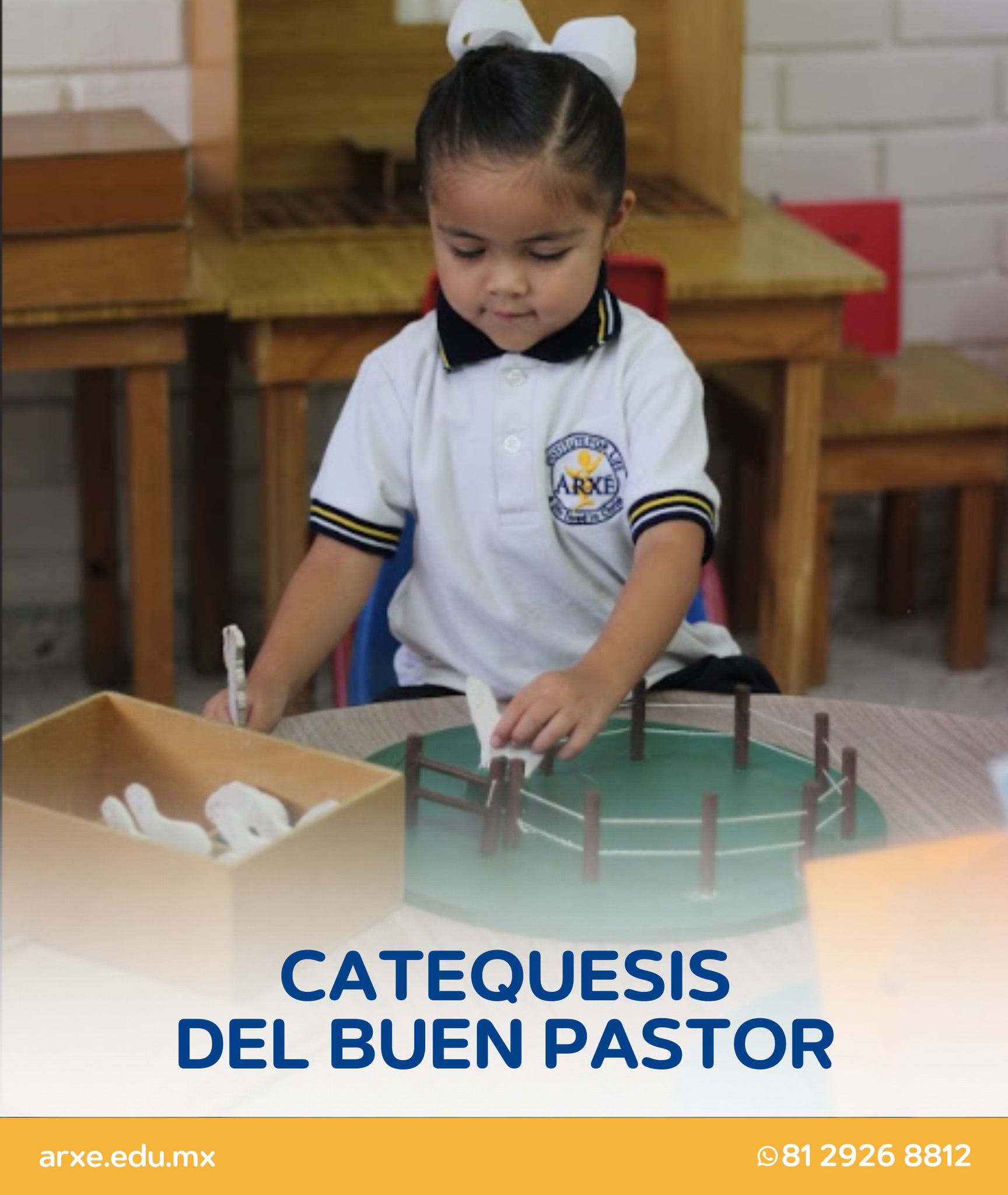
- Children from 3 to 12 pass through the Atrium of the Good Shepherd, a catechesis in the method of Sofia Cavalletti and Gianna Gobbi: few and essential things, materials, silence, not a religion exam. There are three atriums: ages 3–6, 6–9, and 9–12. How that meets the year of reading is in when children learn to read at a Catholic school.
- There is sacramental life: school Masses with a priest during the year, preparation for First Communion, a liturgical calendar that is lived and not only printed. It is not a brochure chapel.
- The formation does not stop at the children. Makarias and Kefas accompany women and fathers, with the Bible and the sacraments. They are not an admissions requirement; they are a path for the adults who also want to grow.
- And we are not giving up on the 21st century: Arxe is a Google Reference School, with English immersion from preschool and French from 4th grade. The school runs from age 2 through junior high, to age 15. We do not have our own high school: our graduates move on to the best high schools in the city.
What science says
Everything above could sound like a father’s and an educator’s wish. So it is worth saying that serious research —done outside schools, by universities— points in the same direction:
- Harvard, in a study that followed thousands of young people into adulthood: growing up with daily religious practice is associated with greater happiness and better health in young adulthood.
- Columbia: a spiritual core developed in childhood sharply reduces the risk of depression in adolescence, even in high-risk teens.
- Developmental neuroscience (Center on the Developing Child, Harvard): in the early years, more than one million neural connections form every second; the architecture of everything learned later is built in that window.
- Oxford (cognitive science of development): children are born with a natural openness to God; teaching the faith answers their own most natural questions — it is not imposed on them.
- The largest study ever done on the transmission of faith (Oxford University Press, 35 years, 3,500 people): what families plant in childhood is not lost; faith is inherited through everyday life together.
These numbers describe trends, not guaranteed outcomes: no study can promise your child’s faith. What they do say is that forming children in faith from the beginning is not a bet against the evidence, but with it. And if the question is whether a child can handle faith, English, and reading at once, we wrote an article just for that: Is it too much for a child?
If you are comparing Catholic options in the city, these two guides order the search: how to choose a Catholic school in Monterrey (what to ask on the visit) and the Catholic schools in Monterrey guide (the city landscape). The school’s life of faith, day by day, also has its own page: faith.
The campus is at Av. Insurgentes 1616, San Jerónimo 1er Sector, C.P. 64630, Monterrey, and it runs from age 2 to age 15. If you want to see how this is lived on an ordinary Tuesday —not at a special celebration—, come. The office is open Monday to Friday, 8:00 a.m. to 4:00 p.m.
Questions parents ask
Do they impose religion on the children?
A good Catholic school proposes; it does not impose. The proof is not in the speech but in how they treat the child who does not pray. If he is respected and the door is left open, it is a house. If he is pressured or made an example of, the faith is scenery.
What is the difference from a secular school with ‘values’?
Every school transmits values, named or not. In a Catholic school they are explicit —truth, justice, gratitude, service— and they rest on a complete account of the person: loved, and made for something. A secular school can be excellent; the question is whether ‘values’ means something a child can hold and question, or a poster on the wall.
Does a Catholic education work if my child drifts away later?
Education is not a contract for spiritual results. A Catholic school sows; it cannot sign for the harvest. What families notice is that the words and gestures of childhood do not disappear. Many young adults walk back through the door they were given, sometimes years later, and find it unlocked.
How do I know whether a school truly lives its faith?
Ask three things: whether there is real sacramental life (Masses that actually happen, with a priest and a date), whether the staff lives what it teaches, and how they treat the child who does not pray. A school that lives its faith is not offended by these questions. It has been waiting for them.
Want to see the faith on an ordinary Tuesday, not in a brochure?
It is understood by walking the campus: the Atrium, the chapel, how they speak about your child. WhatsApp: +52 81 2926 8812.
Is your family looking for a school with real faith?
The quiz does not ask you to believe more. It helps you see whether the school you imagine can hold the questions you already ask yourself.
Take the quiz